
Somers Previous Residents Sources
The strongest order for previous residents is current parcel reference, recorded deed, historical map, then library or archive context. Each source covers a different span and has a different limit. No single record set establishes every person who lived at a Somers address. The dates below describe the source material that was actually located, including the gaps that should stay visible during a house-history or family-history search.
| Source | Years It Covers | Where Held | What It Shows |
|---|---|---|---|
| Somers assessment and parcel reference | Current annual roll cycle; no historic occupancy series located | Somers Assessor and local tax maps | SBL, printkey, property location, and a dated assessment snapshot |
| Westchester Records Online land index | Advertised from 18th-century deeds to recent records; exact Somers cutoff not published | County Clerk / WRO | Recorded party roles, instruments, dates, and title leads |
| County Clerk historical maps | Digitized sample 1793–1928; larger filing body 1774–present | County Clerk collection and County Archives | Roads, historic labels, adjoining-property clues, surveyors |
| NYS Archives vital indexes | Births 1881–1935; marriages 1881–1960; deaths 1880–1960 | NYS Archives | Event and certificate leads, not a property-occupancy record |
| Somers Library local history | Yearbook filters span the 1950s–2020s, with named editions through 2025 | Somers Library | Local books, yearbooks, reference help, and historical context |
| WCHS newspaper and genealogy holdings | Marriage and death material 1828–1896, plus varied collection holdings | Westchester County Historical Society | Family, cemetery, church, newspaper, and manuscript leads |
Begin with SBL and the current legal description when the address is known. Start with a dated library, archive, or newspaper source when the time period is known but the modern address is uncertain. A map or deed may supply the bridge between those two starting points.
Note: Somers source dates describe located material, not a promise that every address or person appears in an online record.
Somers Address Records First
Start the backward trail with the current parcel, not a guessed former name. The Somers Assessor at 335 Route 202 is the local source for assessment and parcel information. Record the SBL, printkey, property or situs address, roll year, and legal-description clues before opening a historical source. The Town says it supplies digital tax parcel data, while the County's GIS is a municipal-supplied convenience layer. The local Assessor's approved tax map is authoritative for tax-map purposes.
Owner name, owner mailing address, and property address can all differ. A mailing address is where notices go, not proof of a home location. In the same way, an annual assessment record provides a dated snapshot rather than a continuous title or occupancy history. Keeping that distinction early makes the search for previous residents more reliable when a property has a trust, organization, shared ownership, or an address that changed form.
- SBL
- Section, block, and lot, a parcel identifier that helps connect tax-map and deed research.
- Printkey
- A parcel reference carried by the Somers GIS layer.
- Situs address
- The location of the property, as distinct from a mailing address.
- Legal description
- The lot, boundary, or other property wording in a recorded instrument, often more stable than a street number.
Somers Previous Residents Deed Chain
With the current SBL and legal description in hand, turn to Westchester Records Online and the County Clerk's Land Records Division. WRO's public description reaches from 18th-century deeds to recent records, but no official public text gives an exact Somers image or index cutoff. Treat the portal as a discovery tool and retain the recording date, instrument or control number, document type, party role, and description for each candidate record.
- Use the Assessor record to capture the present parcel identity and any legal-description wording.
- Search the current owner as a grantee, then compare the resulting purchase instrument with the parcel description.
- Identify the seller in that instrument and search that person or entity as a grantee to locate the earlier acquisition.
- Repeat the change in party role, keeping spelling variants, document dates, book or control references, and road-name differences together.
- When a match matters, verify it with the instrument image or a certified County Clerk copy before extending the chain.
Grantor means the party transferring an interest. Grantee means the party receiving it. A chain of title is the succession of recorded transfers tied to the same property. It can identify past owners or transaction parties, but it does not automatically identify every person who lived there.
Somers WRO Record Limits
WRO offers basic index searching without charge, but images and reports require an account and may require payment or a subscription. The portal's exact public field layout was not fully available without login, and the County Clerk has not published a Somers-specific online cutoff in the official material reviewed. For that reason, record an index result as a lead, not as final evidence. Its date, party role, document type, and control number are useful details to carry to the next step.
The WRO disclaimer says the service is separate from the official record and does not guarantee accuracy, currency, or completeness. Certified-copy questions belong with the County Clerk. Land Records can also be approached in person in White Plains, while the Clerk's services page provides the routing for direct requests and FOIL matters. When no online record appears, it is safer to ask the custodian about the record series than to assume the title trail ends.
Note: A Somers WRO result is a discovery lead until the instrument image or County Clerk copy confirms the record.
Somers Historical Address Maps
The County Clerk Historical Maps collection can connect a former road name, stream, surveyor notation, or adjoining-property clue to a later parcel. The digitized collection samples maps from 1793 through 1928 from a larger body of more than 30,000 maps filed from 1774 to the present. It is a strong source for place history, but it is not a complete parcel file and historic labels are not current boundaries.
No official source located for this project documents a Somers-wide street renumbering or address-conversion date. When an old number does not fit, compare the legal description, SBL, map label, road-name variant, and document date. Do not force an old mail label into a current postal place. A postal label and Town geography can differ, and historic maps should be checked against the local Assessor's tax map when parcel identity matters.
Somers Previous Residents Gaps
Somers does not have a verified city-directory run in the official New York State Library inventory reviewed for this project. The inventory lists regional Westchester, White Plains, Yonkers, and Peekskill runs, but it does not establish a Somers-specific printed run, publisher, last year, or digital scan. It also does not confirm a Somers reverse or criss-cross directory, telephone-book run, or address-to-occupant shelf. Those absences are part of an accurate previous residents search.
The New York State Library directory-holdings page shows the regional collection context and the Somers gap.
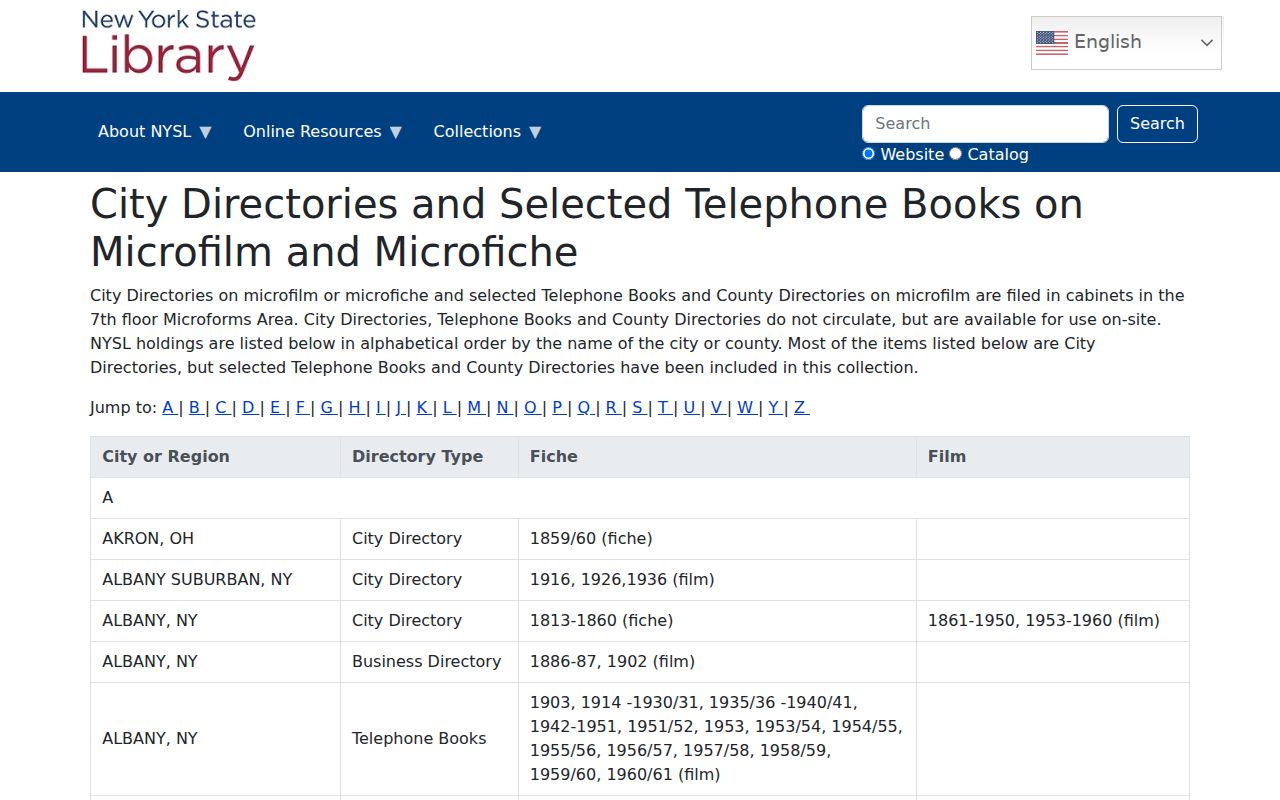
The holdings page is a catalog lead, not evidence that a person or address appears in a Somers directory. A confirmed regional volume can still be useful when its place, year, title, and page are recorded. The Somers historical directory reference keeps that regional collection question separate from the backward property trail.
No official online inventory located a Somers-specific obituary index, complete cemetery database, or digitized Somers directory collection either. Ask Somers Library and WCHS reference staff to check regional directories, Polk or telephone volumes, licensed databases, microfilm, and finding aids before treating a missing online result as a final answer.
Somers Library Records Trail
The Somers Library local-history collection is the local reference stop for books, DVDs, yearbooks, Somers and Westchester sources, and staff help. Its yearbook gallery has filters from the 1950s through the 2020s and lists recent editions through 2025, yet the online page does not identify a complete directory shelf or a named genealogy-database subscription. Ask for a finding aid or a specific source type before requesting an item.
For a more place-specific trail, the Somers Historical Society at the Elephant Hotel offers local images, object material, and oral-history audio. The Westchester County Historical Society adds family histories, cemetery volumes, church records, newspaper marriage and death material, genealogy files, and manuscripts. WCHS reports more than 90,000 photo records, about 14,000 library records, and finding aids for nearly 150 special collections, with many holdings still not online.
Note: Somers Library and WCHS holdings should be confirmed with reference staff before a missing catalog result is treated as final.
Somers Previous Residents Dates
When an authorized library or archive item gives an address clue, transcribe it exactly and keep the source's place, year, title, page, and abbreviation key. Compare the same address in adjacent dated sources only after confirming that the road name and parcel context line up. The research found no verified Somers criss-cross run, so a regional item must be labeled as regional rather than silently treated as local evidence.
- Record the address exactly as a dated publication, map, or yearbook gives it, including abbreviations and postal or hamlet label.
- Compare it with the parcel SBL, legal description, and WRO instrument trail.
- Pair the dated item with the relevant census year, deed, vital-index lead, newspaper, church, cemetery, or oral-history source.
- Mark each conclusion as documented in a source, an inference, or not located, rather than filling a gap with a name match.
A census reference may provide a household-level cross-check, but it still needs the same address and date discipline. A directory or yearbook is a dated publication, not proof that every person connected to an address lived there or remained there later.
Somers Archives Record Leads
The New York State Archives vital-records page explains the historical index ranges and the separation between an index and a certificate.
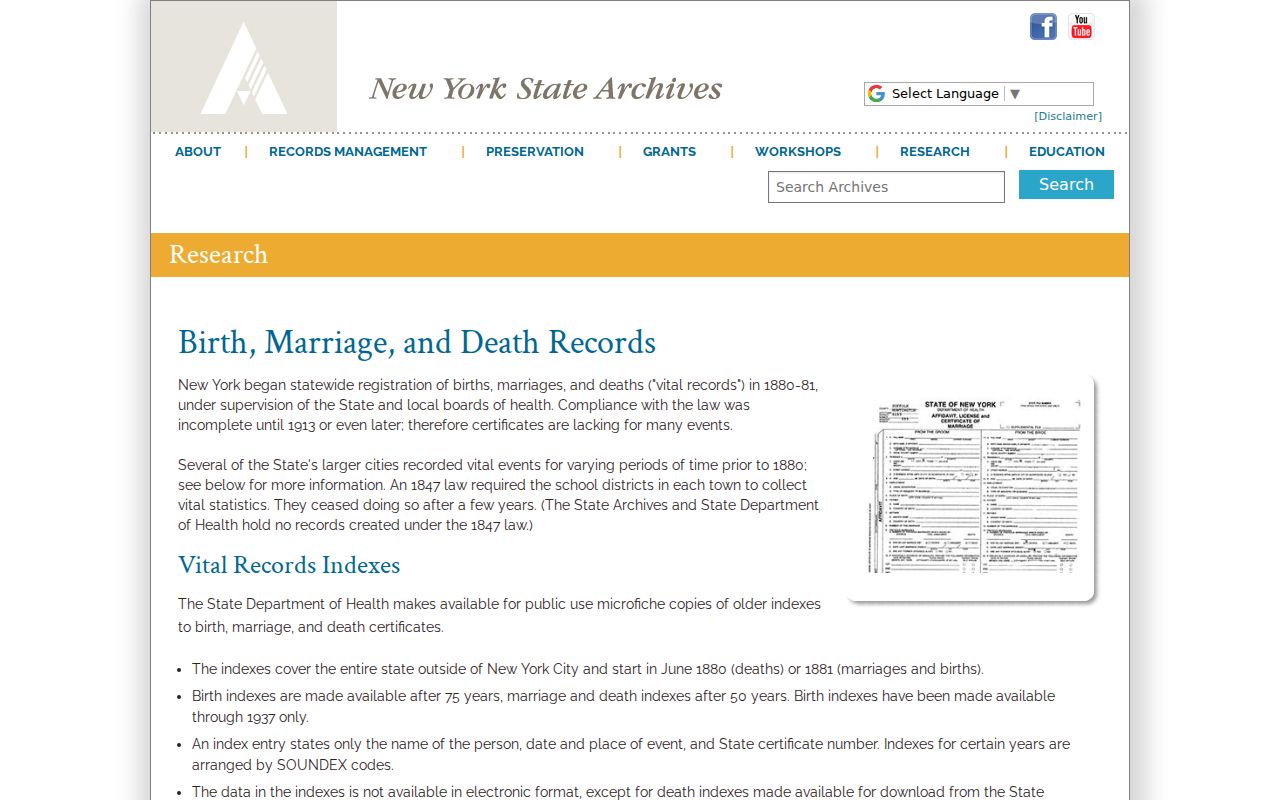
Its microfiche coverage is births from 1881 to 1935, marriages from 1881 to 1960, and deaths from 1880 to 1960. The index can supply a name, year, event, location, or certificate-number lead when available. It does not prove an address history, and the Archives does not necessarily hold the certificate for every event. Certificate copies come through the Department of Health under its eligibility and genealogy rules.
Note: A Somers archive-index match needs a separate property or dated local source before it can support an address conclusion.
Somers Reservoir Records Clues
Place history can explain why a record trail changes form. The Town's official history says Croton and Muscoot River flooding for New York City reservoirs displaced farms, mills, and businesses between 1890 and 1910. It also notes rail connections near Purdys, Croton Falls, and Lincolndale, plus later lake communities. Use those facts only as location clues. Test a former place name with a deed, historical map, oral history, or archival source before connecting it to an address.
The same history identifies The Somers Museum, a newspaper that ran from 1809 to 1811, as a specific archive search term. Confirm whether an institution holds an issue, microfilm, an index, or only a citation before using it in an address chronology.
Somers Previous Residents Limits
Past owners, past residents, and former household members are not the same category. A deed chain follows recorded interests in property. A confirmed directory, census, newspaper, yearbook, cemetery, church, or oral-history item may add a dated personal connection, but each source needs its own date and context. Probate and obituary material can sometimes supply a historical endpoint for a deceased person, yet the research did not locate a complete Somers obituary or cemetery index online.
Use this material for lawful family history, place history, estate research, or civic understanding. Do not use it to find a living person's routine, to make unwanted contact, to stalk, or to harass anyone. A missing entry can result from confidentiality, a changed name, incomplete digitization, a mailing address elsewhere, or a source that has not been located. Return to the custodian or reference desk for clarification instead of treating an absence as proof.
Respect the record. Keep historical conclusions tied to a dated source and avoid republishing personal details that are unnecessary to the property or family-history question.